A Sensor Shift has Begun:
Capturing Subtle Forces, Enhancing Control Considerably

As robots and medical equipment continue to change the world, designers have noticed one consistent issue: control.
Regardless of technological innovations, every single robot and medical equipment offering will always require very sophisticated control—preferably the highest amount possible.
To achieve such control time after time, designers are striving to accurately determine how much force should be applied as they create each product. They’re also seeking to detect the exact amount of contact they’ll need for every product.
If they don’t, their robots and medical equipment will be negatively impacted. Not only will their control be minimized, but their products’ safety and overall performance will decline sharply as well.
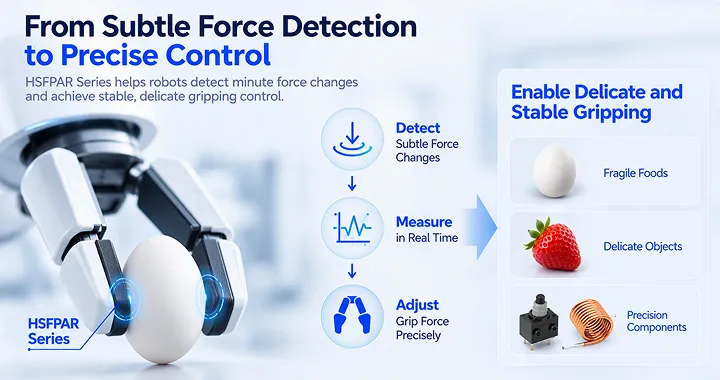
In order to help manufacturers fully overcome these potential issues once and for all, Alps Alpine had a novel idea—to develop a force sensor lineup. Known as the HSFPAR Series, the sensors address each of these persistent challenges.
First, it can detect any minute change in force extremely accurately, over and over again. In fact, its force range is quite extensive, from 0 to 20 newtons. As an example of how extensive this range truly is, a force of 1 newton equals roughly the weight of a small apple as it sits in your hand. Twenty newtons? That’s approximately equal to the weight of 20 apples, a high differentiation in force!
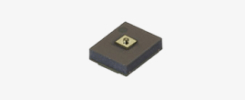
Each sensor is very thin and compact, too. For instance, one member of the sensor lineup, known as the HSFPAR304A, is only 4.20 millimeters long, 3.60 millimeters wide and 2.69 millimeters high. As a result, it can be effortlessly integrated into practically any space-constrained mechanism. In turn, it can measure nearly any product’s force—without impacting its design. If, for some reason, a design is impacted, the influence is minimal, at most.
Every HSFPAR304A sensor provides variety in several other ways as well. For starters, each sensor’s operating temperature ranges from -40°C to 85°C. Its supply voltage also varies extensively, from 1.5V to 6V. Offering a 200-newton maximum load rating too, each of these variations enable the sensor to capture virtually any type of force.

For example, it can capture even the most subtle forces. Minimal forces often occur whenever manufacturers conduct actions like grasping, pressing or touching. Although the forces change subtly, the variations are continuous, beginning at the moment contact first occurs.
The sensor also captures each of these subtle, steady force variations on a consistent basis, entirely in real time. Consequently, it enables a critical shift to occur—from conventionally discrete control methods (that rely on specific timing points or threshold values) to control strategies based on continuous force data.
Due to this shift, manufacturers can enhance their control reproducibility considerably. At the same time, they’ll decrease any performance variations too, which were once noticed from one unit to another.
In addition to this improvement in force detection, the HSFPAR304A sensor is renowned for its longevity, as its operating life is currently 1 million cycles. Utilizing a surface mount device (SMD) unit, the sensor can easily be mounted onto a printed circuit board, leading to effortless installation as well.
Furthermore, the sensor, which has an analog voltage interface, provides manufacturers high sensitivity. Typically, the industry standard is 2.0 mV/V/N (2 millivolts per volt). However, the HSFPAR304A has a sensitivity rating of 2.3 mV/V/N. In other words, its load cell outputs 2.3 millivolts of electrical signal for each volt of excitation power—whenever it’s loaded to its maximum capacity. This high sensitivity enables the sensor to notice any subtle force changes quickly, accurately and consistently.
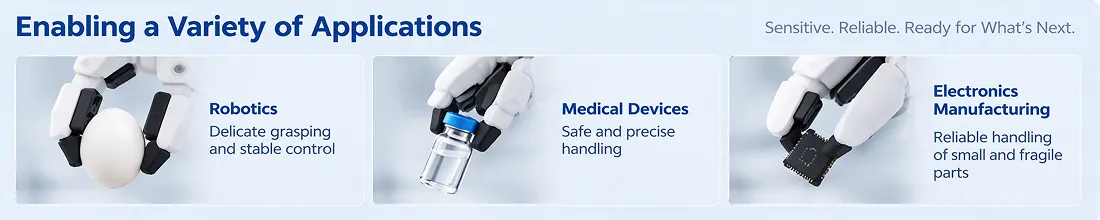
As a result of these distinctions, the HSFPAR304A—along with the HSFPAR Series as a whole—is becoming increasingly popular. Whether manufacturers are creating applications like robotic fingertips or moveable components that will be used in medical devices, they’re seeking more and more force control. As demand for force control steadily rises, the series is consistently meeting manufacturers’ requests.
Following in suit with the ever-rising amount of applications that utilize force sensing technology, the HSFPAR Series’ sensitivity will also steadily rise. Thus, it is replicating human touch and sensation more and more, while minimizing common human errors, too
Therefore, success stories are surging at a rapid pace, with regard to customers’ usage of the HSFPAR Series. As an example of these successes, the following case study highlights how the series is being used for real-world products and systems, resulting in positive influences—on the robotics and the medical device industries.
As potential users prepare to potentially utilize the series as well, Alps Alpine believes these success stories will empower their decisions. Now is the time for new HSFPAR Series users to join thousands of others, as they manufacture new robots and medical equipment for future customers.
Robot Manufacturer: “R” Company
Higher Control, More Consistency and Stability: Integrating Force Sensors into Robotic Fingertips
As an industrial robotic arms manufacturer, “R” Company encountered numerous challenges during its component-handling operations. In particular, manufacturers were unable to fully control their gripping forces. A key reason? While using conventional methods—based on position control and motor current monitoring—they struggled to accurately detect each exact moment of contact.
Manufacturers were also unable to determine how much force was actually being applied every time. As a result, excessive gripping force was often a key issue, leading to part damage. Or, at times, insufficient force was noticed as well, resulting in unsuccessful grasping.
Each of these challenges became even more pronounced as manufacturers handled components that varied substantially, from their shapes to their material hardness. During these moments, fixed control parameters were often inadequate. Instead, manufacturers sought a mechanism that could adjust their gripping force, based entirely on tactile feedback. The best comparison? Think about how a human finger not only senses contact but responds to it, too.
This type of mechanism certainly seemed to be suitable for the manufacturers. However, there was one other issue. A robotic gripper’s fingertip area typically has severe space constraints. Therefore, it’s impractical for manufacturers to add large sensors to it. They also can’t significantly modify its mechanical structure either.
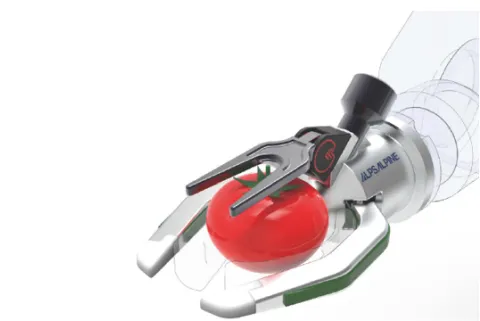
Hence, to address each of these issues, the “R” Company began to evaluate Alps Alpine’s HSFPAR Series Force Sensor. Above all else, they were focused on its thin, compact design, along with its ability to detect minute changes in force consistently and quickly.
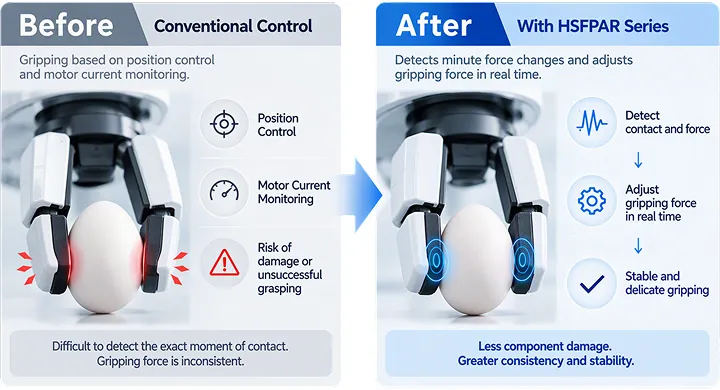
Since each force sensor can be integrated directly into a robot’s gripper fingertips, it may potentially monitor contact events and force variations throughout the gripping process—completely in real time. Thus, “R” Company believes the sensor will be a key technology application down the road, especially when it comes to gripping force control.
While preparing for the future, a variety of other positives have been noticed. First, the risk of component damage has declined. This reduction has typically occurred whenever force feedback is used. Such feedback is generally used to adjust gripping force, particularly once contact is detected, Not to mention, the “R” Company’s gripping operations’ overall consistency and stability have improved as well.
Rather than simply “grasping” an object, “R” Company’s robotic systems can “grasp while sensing” now. In turn, the company’s robotic manipulation is closer to human touch’s adaptability and precision than it ever was before.
With each of these critical positive changes in mind, the “R” Company is focusing on using more sensors in the near future. In response, Alps Alpine is preparing to develop more HSFPAR Series Force Sensors, as the “R” Company seeks to fully realize their capabilities.
The momentum has begun. The future is bright. And Alps Alpine’s HSFPAR Series Force Sensors are leading the way for more success stories, similar to the “R” Company’s.