Thermal Management Technologies
Alps Alpine’s Thermal Management Technologies: Achieving Both Performance and Safety
As automotive equipment and digital devices continue to become more powerful, thermal design has become a critical technology that directly affects product performance, reliability, and safety. By combining advanced thermal design, thermal simulation, thermal evaluation, and cutting-edge heat dissipation technologies, Alps Alpine’s thermal management technologies optimize heat control while enabling both higher performance and greater miniaturization of digital devices.
Thermal Design Technology
Why Is Thermal Design Necessary?
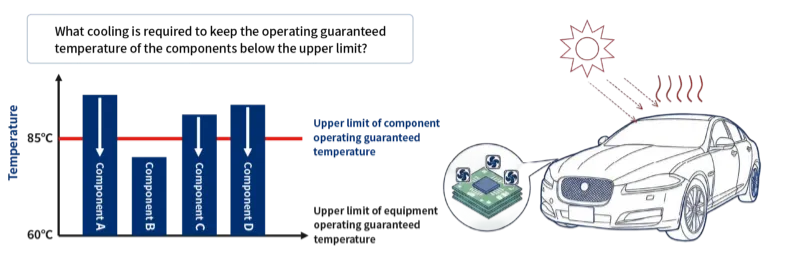
Electronic devices contain circuit boards equipped with semiconductor chips, which generate heat during operation. If thermal management is insufficient, excessive heat can cause fires, smoke generation, malfunctions, and premature component failures, leading to reduced safety, performance, quality, and reliability. This is especially important for automotive products, which must operate reliably under harsh conditions, such as high cabin temperatures caused by direct summer sunlight and prolonged periods of use. Therefore, effective thermal design is essential for properly controlling generated heat.
However, thermal design cannot be optimized in isolation. For example, cooling fans used to improve thermal performance may generate undesirable noise inside a vehicle cabin. In addition, efforts to make products smaller and thinner due to design requirements and limited installation space can increase heat concentration. Therefore, thermal designers must balance multiple requirements, including functionality, reliability, size, and cost, while efficiently controlling heat generation.
Enhancing Quality Through Early-Stage Thermal Design
At Alps Alpine, thermal challenges are addressed from the earliest stages of product concept development based on a “front-loading” approach. By understanding power consumption and heat generation at an early phase, engineers can determine the need for heat dissipation mechanisms such as cooling fans and heat sinks. Improving design quality at this stage helps minimize the risk of design modifications and additional thermal countermeasures later in the development process.
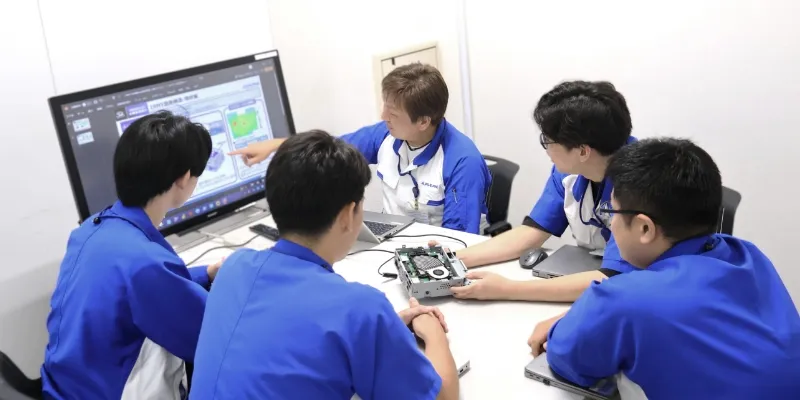
Thermal design activities involve three perspectives: product designers, thermal analysis engineers, and thermal experts. Product designers ensure compatibility between functional and structural requirements, analysis engineers predict temperature behavior through simulation, and thermal specialists conduct reviews. Together, these efforts contribute to improved product reliability.
Thermal Analysis and Evaluation Technologies
Systematic and Comprehensive Thermal Analysis
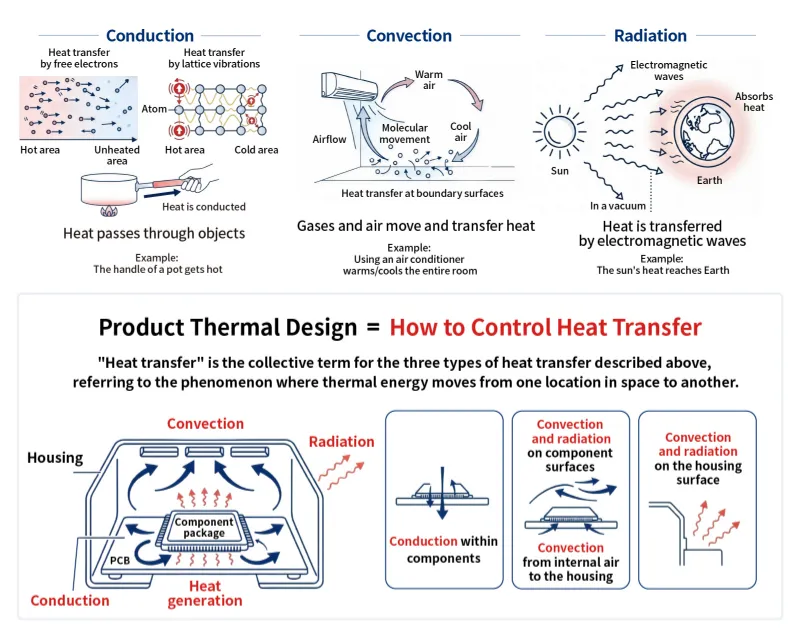
A thorough understanding of the three modes of heat transfer, namely conduction, convection, and radiation, is essential in thermal design.
- Conduction refers to the transfer of heat within a material or between objects in direct contact.
- Convection refers to heat transfer caused by the movement of fluids such as air or liquids.
- Radiation refers to heat transfer through electromagnetic waves, including infrared radiation.
In electronic devices, heat generated by semiconductor chips is conducted through circuit boards and enclosures, then dissipated into the surrounding environment through convection and radiation. Effectively combining these three heat transfer mechanisms to remove generated heat from the enclosure is the key objective of thermal design.
Alps Alpine predicts heat flow from heat-generating sources to the ambient environment by utilizing multiple analysis tools. First, thermal calculation tools are used to quickly evaluate how circuit boards and heat dissipation surface areas affect temperature, helping engineers determine the direction of thermal countermeasures. Next, thermal-fluid simulations visualize internal temperature distributions and airflow patterns within products, allowing engineers to assess component temperatures and consider potential improvements. Finally, 1D CAE tools are used to predict semiconductor chip temperature rise and verify whether components will operate within appropriate temperature ranges. By combining these approaches, highly accurate thermal analysis can be achieved from the earliest design stages.
In addition to simulation tools, actual product evaluations are conducted. Comparing measured temperature data and thermal distribution results with simulation outcomes improves model accuracy and enables more reliable thermal design.
Design Optimization Through Thermal Analysis and Real-World Validation
One example of successfully balancing product performance and quality through the combination of thermal analysis and physical testing is the BIG X, a large-screen navigation system designed specifically for individual vehicle models.
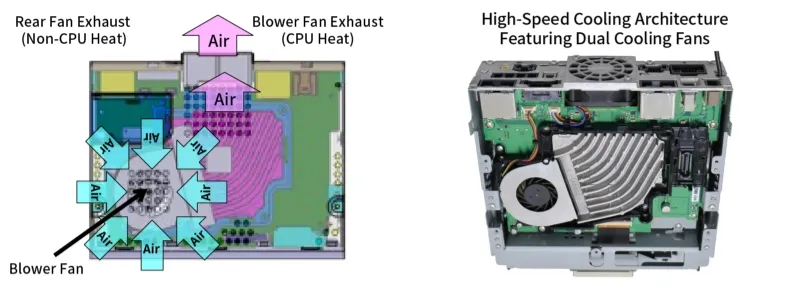
The BIG X incorporates a high-performance CPU along with a GPU for video processing and a DSP for audio and image processing, all of which generate significant amounts of heat. To address this challenge, the system employs separate heat dissipation paths for the CPU and other electronic components. A dedicated cooling fan is assigned to the CPU, while a separate fan cools the remaining components. This allows cooling strategies to be tailored to the thermal characteristics of each device.
In addition, airflow management between intake and exhaust paths enables efficient heat removal within the limited space available inside the enclosure. These thermal design innovations contribute to the system’s ability to deliver both high performance and superior audio quality.
Advanced Heat Dissipation Technologies
Exploring Vapor Chamber Technology
To prepare for future increases in power consumption and heat generation, Alps Alpine is actively investigating the use of vapor chamber technology.
While cooling fans and heat sinks are currently the primary thermal countermeasures for automotive equipment, these solutions alone may not be sufficient for next-generation high-power devices. Vapor chambers are therefore attracting attention as an advanced thermal management technology capable of delivering both exceptional heat spreading performance and space efficiency.
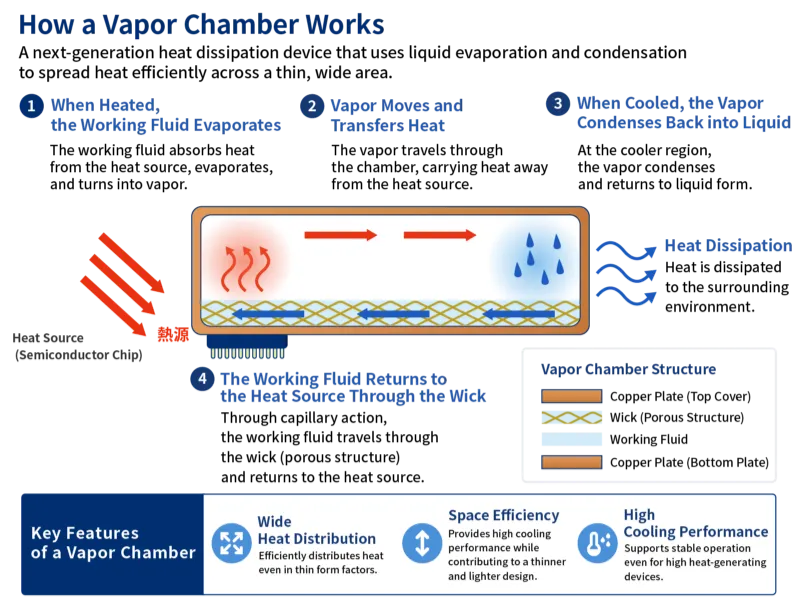
A vapor chamber is a heat dissipation device that rapidly spreads heat over a wide area. Its internal structure contains a working fluid and a mechanism that enables heat circulation. By utilizing the evaporation and condensation of the fluid, heat can be transferred efficiently throughout the device.
This mechanism prevents heat from concentrating in localized areas and spreads it across a broader region, effectively suppressing temperature rise in high-power devices. As a result, vapor chambers are regarded as a promising next-generation cooling technology capable of addressing thermal challenges that are difficult to solve with conventional heat sinks and fans while also supporting compact product designs.
Alps Alpine is collaborating with the Kanazawa Institute of Technology to improve heat dissipation performance through precision microfabrication technologies. The collaboration also focuses on visualizing internal thermal behavior and optimizing thermal resistance models to improve the accuracy of thermal performance prediction.
The Future of Thermal Design for Autonomous Driving
Looking ahead, the adoption of autonomous driving technologies, larger automotive displays, and increasingly powerful processors is expected to further increase power consumption and heat generation in automotive equipment. At the same time, continued demands for thinner and smaller products will reduce the space available for thermal solutions, making thermal design even more challenging.
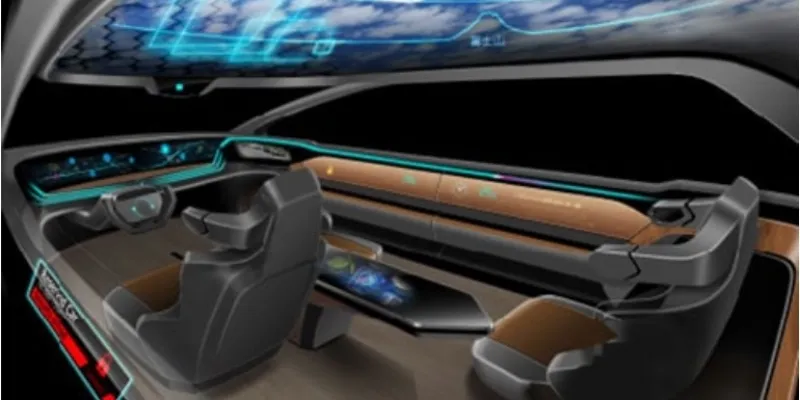
Alps Alpine is working toward the realization of a Digital Cabin that transforms the entire vehicle interior into a safe, comfortable, and inspiring space. Achieving this next-generation mobility vision requires highly reliable thermal design technologies that ensure stable operation of increasingly sophisticated electronic systems. Consequently, the importance of thermal management will continue to grow.
By further advancing its integrated thermal management technologies that combine design, simulation, and real-world evaluation, Alps Alpine will continue contributing to improved safety and reliability for next-generation mobility solutions and digital devices, both of which demand higher performance and greater miniaturization.