System Modeling Technology
System Modeling Technology for Advanced and Efficient Development
— Integrating Mechanics, Electronics, and Software
As products become increasingly complex, systems in which mechanics, electronics, and software are closely intertwined continue to grow in sophistication year by year. Against this backdrop, Alps Alpine leverages system modeling technology to capture the structure and behavior of entire systems in a visual and logical manner.
Alps Alpine’s Vision for System Modeling Technology
At Alps Alpine, system modeling refers to a technology that abstracts complex real-world phenomena into diagrams and mathematical models, enabling a clear understanding of relationships and behaviors among system components.
By doing so, mechanical, electronic, and software designs—traditionally developed independently—can now be discussed and verified from a shared perspective. This approach significantly contributes to early identification of issues and reduction of rework in the initial stages of development.
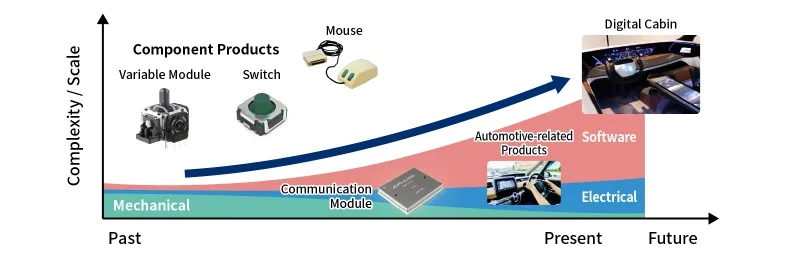
In the company’s early years, development was centered on components primarily based on mechanical structures. However, as society became increasingly electrified, electronics technologies and software development rapidly grew in importance.
In recent years, particularly in automotive products such as automated driving and advanced driver-assistance systems (ADAS), software has come to play a central role. As a result, an integrated approach based on system modeling has become indispensable.
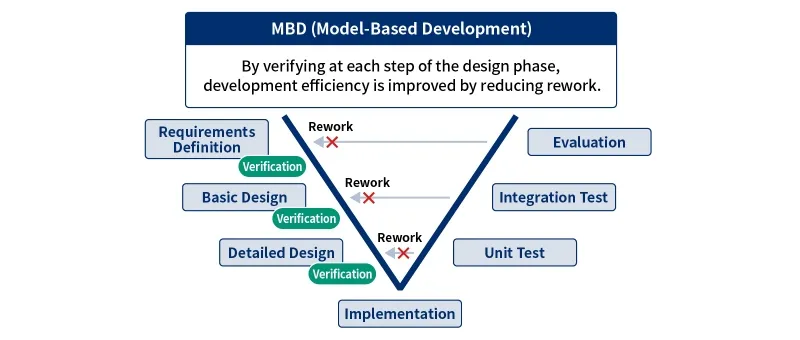
To address these changes, Alps Alpine has accumulated modeling expertise grounded in energy conservation laws and physical principles and has widely adopted Model-Based Development (MBD), an early verification–oriented development approach.
Parallel Development and Rework Reduction Through Shared Models
— Development Innovation Enabled by MBD
One of the greatest strengths of modeling technologies, including system modeling, is their ability to serve as a common language shared across organizations with different areas of expertise.
For example, control models allow mechanical designers and software engineers to discuss and evaluate designs from the same viewpoint while referring to a shared model. This reduces misinterpretations of specifications and gaps in understanding between departments, enabling true parallel development across multiple domains.
Another major advantage is that simulations based on models make it possible to virtually verify system behavior even before physical prototypes exist. By repeatedly validating models at each stage—requirements definition, basic design, detailed design, and implementation—issues and specification changes that previously emerged in later phases can be identified much earlier. This significantly reduces rework, shortens development timelines, and helps ensure product quality.
In recent years, the exchange and sharing of models with customers and business partners has also increased. This trend promotes mutual understanding of specifications, accelerates development speed, and improves efficiency across the entire supply chain. In some cases, models themselves have become deliverables, signaling a shift toward an era in which model quality directly impacts product quality.
Principle-Based Modeling Visualizing “Why It Behaves This Way” to Deepen Engineering Insight
Alps Alpine’s system modeling technology goes beyond simple visualization. It emphasizes reproducing system behavior mathematically based on fundamental principles such as energy flow, physical laws, and control theory.
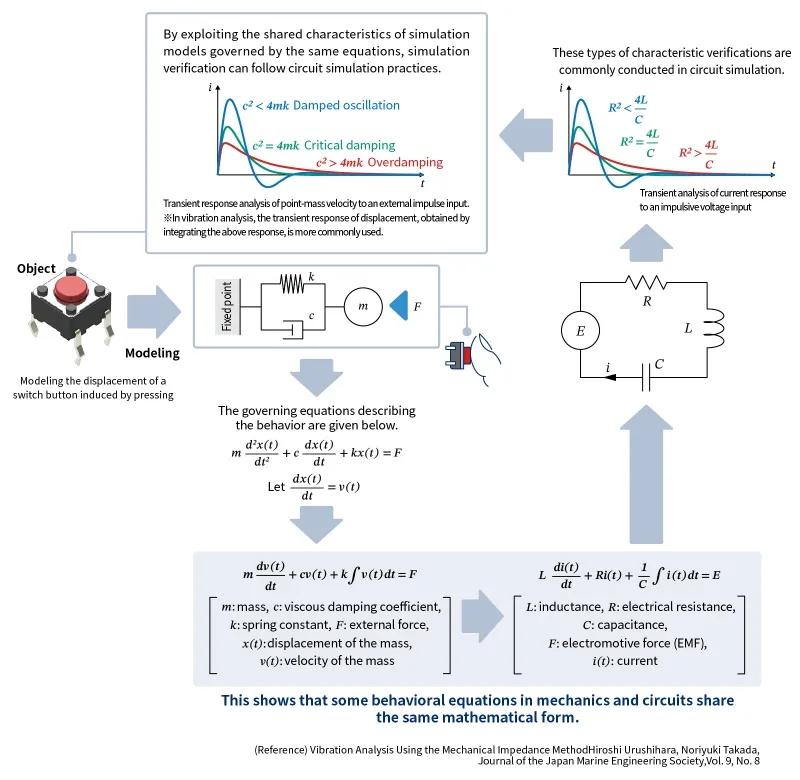
For example, the mechanical behavior of a switch operation can be formulated as a dynamic model and equivalently transformed into an RLC circuit model, enabling analysis from a common perspective across different engineering disciplines. Similarly, the motion of a falling object under air resistance can be modeled using second-order differential equations derived from Newton’s laws, making it possible to analyze terminal velocity and transient responses.
Designing systems with a clear understanding of their mathematical behavior enhances reproducibility and validity, while also contributing directly to the technical growth of engineers themselves. By returning to first principles—even for complex phenomena—new insights and improvement opportunities emerge, ultimately leading to innovative functionality.
Example: Modeling Tact Switch Operation
A Development Platform That Balances Tactile Feel and Control Performance
System modeling technology is already being applied to a wide range of Alps Alpine’s automotive products. A representative example is an in-vehicle shifter developed to enhance driver usability. By modeling the behavior of mechanical, electronic, and software components and combining them with proprietary vibration control algorithms, the system precisely reproduces operational feedback. This results in a refined, reassuring tactile experience. These technologies have become a core element of data-driven development and continue to enhance the value of many products.
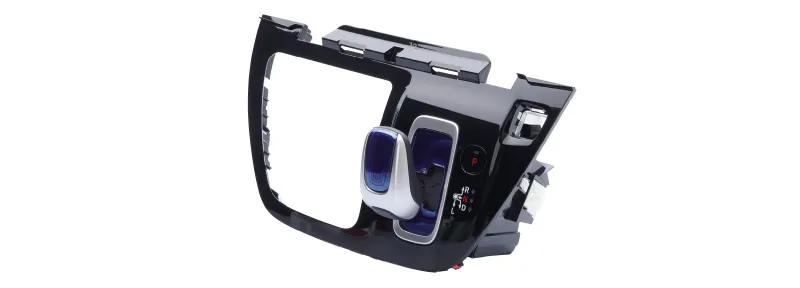
Figure: Automotive Shifter (also known as a shift lever)
System modeling is a foundational approach to front-loading* and serves as a core enabling technology that simultaneously improves development efficiency and sophistication. Alps Alpine will continue to advance this technology, integrating mechanics, electronics, and software to drive unified product development and create new value.
*Front-loading: A development approach that identifies issues in the early stages to reduce rework in later phases.