Kansei Engineering
Alps Alpine’s Kansei Engineering: Endeavors to Quantify Human Sensibility
We feel various things in our day-to-day life. Things like operability or a light, responsive feel can be summed up in one word, but it is difficult to express, in physical and quantitative terms, the reasons why we perceive them that way. Alps Alpine endeavors to incorporate and utilize Kansei Engineering (Affective Engineering), a process that quantitatively evaluates what humans feel, in the design of its products.
What is Kansei Engineering?
At Alps Alpine, we define Kansei Engineering as “techniques to improve the value of products through human-centered engineering.” Experiences such as luxury and comfort engage human emotions.
Here is how Alps Alpine goes about developing products. First, we learn about kansei (affective) value—how humans feel in each situation—which we then evaluate at a physical, quantitative level. The aim of Alps Alpine’s Kansei Engineering is to determine how the kansei value we have evaluated can be utilized in our product design.
With that said, kansei is not newly created. Luxury, for instance, is recognized in comparison to other luxurious experiences the user has had. This means that while quantitative evaluation is important, commonality with other products in society is also key.
Luxury and comfort are among the kansei elements that customers are most interested in. But when we try to express those sensations to other people in words, we often use adjectives or metaphors—what we call kansei terms—that cannot accurately convey what we mean. To solve this problem, we have begun breaking these kansei terms down into three levels.
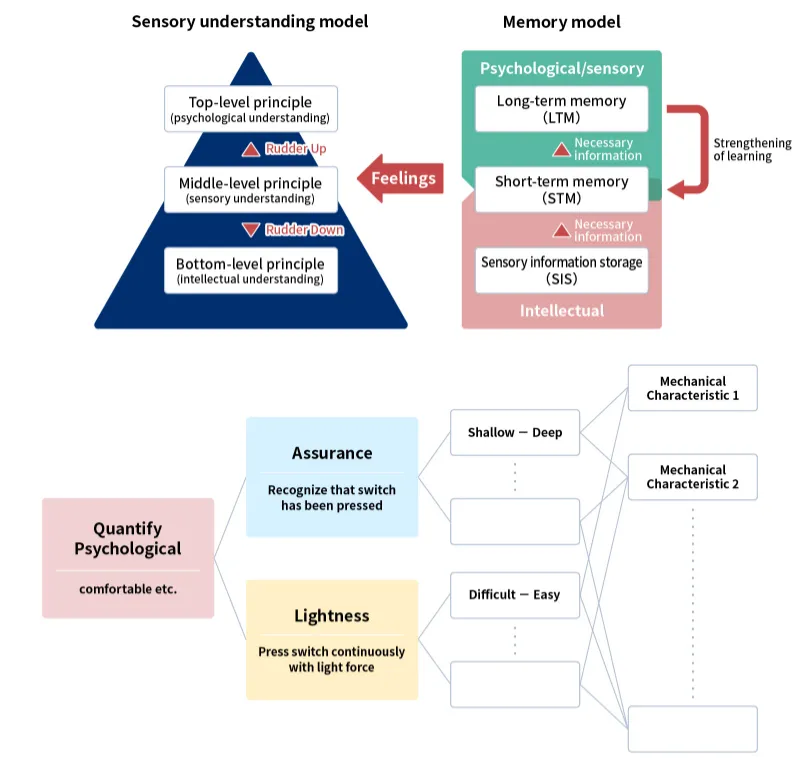
The highest level is the psychological level. This level is for true kansei terms, such as a sense of luxury. The next level is the sensory level, which is for more specific sensations such as clarity and lightness. And then the lowest level is the physical level, which is for things that can be expressed quantitatively such as the force required to operate something or the click distance.
In doing so, we turn those vague kansei expressions into accurate expressions based on physical quantities and map comfort and clarity according to standards in a process called “kansei mapping.” By positioning various products on this map, we can make relative comparisons and have specific conversations about the areas in which we are not on the same page as our customers.
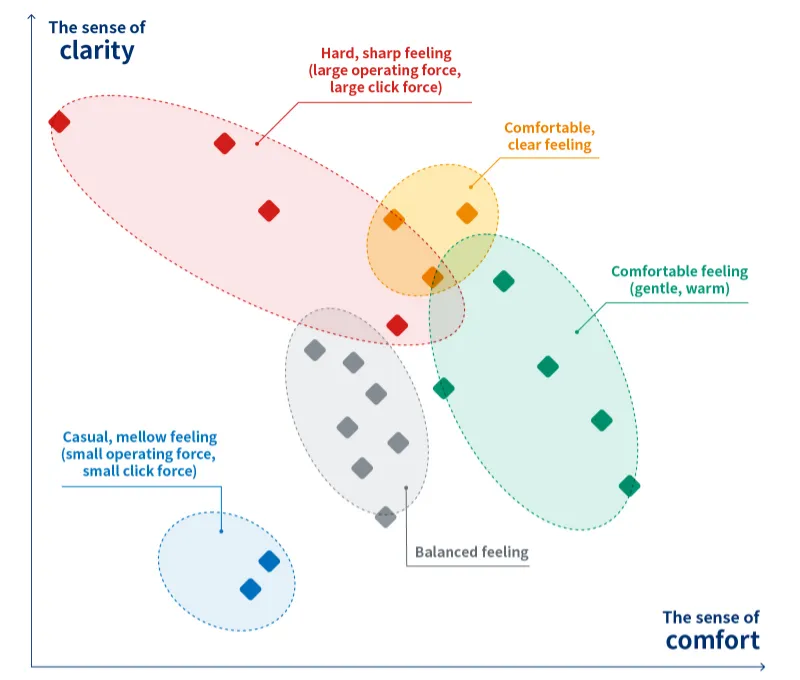
The Kansei Engineering in Alps Alpine’s product design utilizes the TACT Switch™, which is used in various physical switches, and tactile devices used for display buttons.
The mission of “shaping a future where technology extends your senses” is even stipulated in our corporate vision, demonstrating how highly Kansei Engineering is prioritized in our technologies.
Translating kansei into technical systems
The science of comfort when pressing switches
The physical quantities found by breaking down kansei terms is utilized by our developers in the development of our products. An “F-S curve” is used, with stroke (S) on the X axis expressing click distance and force (F) on the Y axis expressing the force exerted during operation. This graph can be used to understand the sensation experienced by users when pressing a switch. For example, even among switches that require the same operating force, those with a shorter click distance feel sharper while those with a longer click distance feel softer.
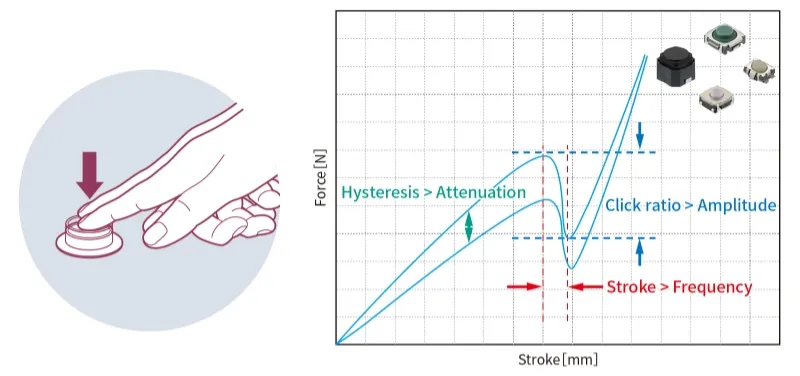
The TACT Switch™, a major product of Alps Alpine’s, was developed by conducting analyses using an F-S curve. The TACT Switch™ is used for various switches in automobiles, and the feel that is needed varies depending on the purpose of each switch. For example, a light touch is best for buttons like those used to adjust the temperature of the air conditioning, as these are operated frequently and present minimal hazards when pressed unintentionally. On the other hand, switches controlling functions like auto cruise control, which tracks the car in front, require a heavier touch because it is dangerous to press these unintentionally.
The TACT Switch™ contains a dome-shaped metal spring; the feel of the switch is changed by adjusting the thickness of this spring. The thickness cannot be determined without a rationale, however, so the physical quantities based on the kansei terms are used to create variations in thickness.
Kansei evaluation of sensations
In the past, evaluations were conducted based on the subjective feelings of the test subjects using the kansei terms and the experience of the tester. However, this method did not shed much light on the relative link between psychological quantities, such as a sense of luxury or comfort, and mechanical characteristics (physical quantities). We therefore adopted an evaluation grid to improve user experience by defining sensations of comfort and standardizing designs.
The evaluation grid is utilized in interviews with subjects to determine the causation between the respective concepts of the top level (psychological understanding), middle level (sensory understanding), and bottom level (intellectual understanding). For example, let us say that we want to choose the “most comfortable” of three types of switches. After operating all of the switches, users are asked which switch they think is most comfortable and their psychological understanding and intellectual state are explored based on their sensory understanding when operating the switches. By summarizing this information, we can define “a comfortable switch” as one that provides clear tactile confirmation of actuation but is light enough to be pressed with a light force.
It should be noted that comfort is created through a combination of vision, tactile, and auditory information; this is called “cross-modality.” Alps Alpine particularly focuses on analyzing the cross-modality between tactile and auditory information, as the creation of a comfortable combination of senses requires not only optimization of each sensory experience but also adjustment of their respective priority levels. Alps Alpine has the knowledge and technology to adjust these elements, enabling us to appeal to multiple senses at once.
General application of Kansei Engineering
The kansei experiences that customers want from designs
Customers express what they want in kansei terms such as “a sense of luxury” and “comfort.” Not all customers are able to express these kansei terms in quantitative expressions, so Alps Alpine helps them.
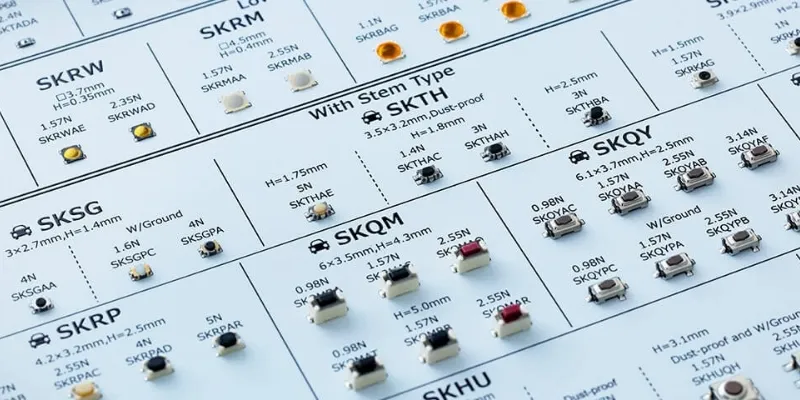
For example, we bring samples of switches to business talks so that customers can try operating them. When feelings like a sense of luxury or comfort are put into words, we discover that there is some variance in the level of each feeling that each customer is looking for. We therefore bring multiple samples covering a range of tactile sensations to determine the specific kansei experience of each customer. Sometimes operating the samples themselves helps to clarify the customer’s kansei experiences, and we have received extremely positive feedback.
Haptic devices balancing functionality with appealing designs
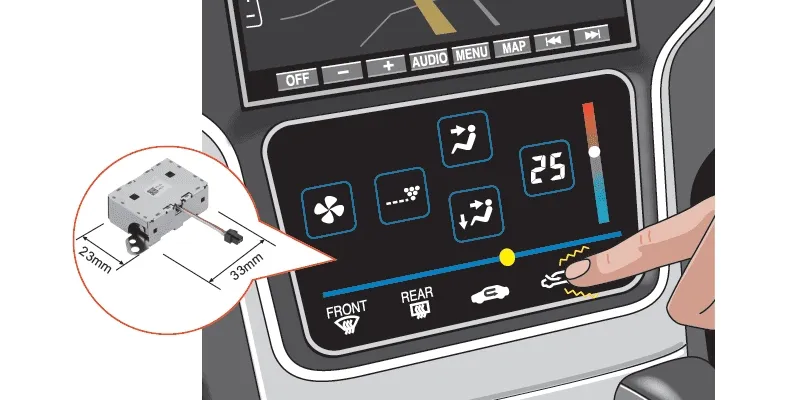
The term “haptic devices” refers to devices such as touch displays where a command is executed upon pressing an area with no physical switch. Vibration indicates to the user that the switch has been pressed (haptic feedback technology.)
In recent years, large touch displays similar to a tablet have been installed in an increasing number of automobiles. This is to accommodate the increase in functions and settings in automobiles. It provides greater freedom in design, enables manufacturers to create instrument panels with excellent designs, and even improves water resistance as, unlike physical switches, there are no gaps.
Additionally, it is considered that haptic feedback should provide a sensation as close as possible to that of conventional physical switches. Since many people have experience with physical switches, haptic feedback would feel odd if it differed significantly from physical switches. Alps Alpine’s experience with both the TACT Switch™ and haptic devices is an asset when it comes to replicating that sensation.
R&D and industry-academic collaborations
Alps Alpine is carrying out a variety of research on HMIs (human-machine interfaces.) For example, our research on cross-modality combining visual, auditory, and tactile experience includes research to create F-S curves from kansei-axis maps: quantification of kansei.
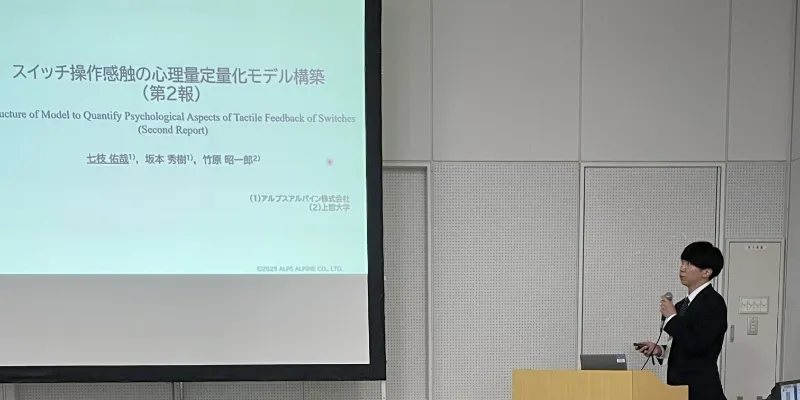
Sometimes people know that a design or sensation during use is good but cannot quantitatively explain why. Kansei Engineering is needed in order to quantify those vague concepts and words. We have presented the results of our research in this area to various academic societies such as the Society of Automotive Engineers of Japan and the Acoustical Society of Japan.
We also conduct joint research with universities. Our partners include Tohoku University, Chuo University, and Sophia University, with topics including affective understanding of the operating feel of switches, confirmation of the relaxing effect of using vibrating elements, and elements of cross-modality created by building structures embodying tactile and auditory experiences.
Automobiles have various switches, and one texture can influence users’ impressions of the car as a whole. Additionally, the feel of a switch or the haptic feedback provided gives the user the assurance that the device has registered the operation in question. Alps Alpine will continue R&D for various switches to improve kansei value for users.
New developments in Kansei Engineering
Areas of application beyond switches
Alps Alpine’s Kansei Engineering is being applied in various areas beyond automotive switches.
For example, gaming devices provide haptic feedback so that the user feels impact when they are attacked, creating a more realistic and immersive experience. In encoders used for purposes such as adjusting the volume on in-vehicle devices, the operating feel and the feel of the clicks when rotating knobs are optimized to enable intuitive operation of interfaces even when driving.
Future-looking endeavors
Alps Alpine’s ultimate goal for our kansei technology is a world with seamless connection between human kansei and items. Our core foundations for achieving this are our technology for quantifying human sensations and our technology for optimizing physical stimulation, which we have developed through current technology such as our TACT Switch™ and our haptic devices.
Alps Alpine’s view for the future is one where these technologies are combined with cross-modality and metaverse technologies to shape technologies with the ultimate appeal to human kansei and a future where human brain activity interfaces seamlessly with machines so that technology allowing humans to operate devices with their thoughts alone and the human brain to intuitively pick up information from devices will become a part of our daily lives.